Showing posts with label Places. Show all posts

Friday, February 10, 2017

Memories about Altadena's Grocery Stores

We received so many memories from readers commenting on our January 2017 post about the closing of Ralphs, that we decided to include them here: 

Dick Bale wrote:
The store described in the blog as being on the southwest corner of Fair Oaks and Mendocino, was actually just south of Harriet. It was owned and operated by the McQuown family in the late 1930s through the ‘40s – perhaps later. Our home was just a few doors from the store and as a nine year old I liked to hang out with the man who operated the produce department. I’d help trim a crate of lettuce, pulling off any damaged leaves and rinsing the head in an outdoor sink behind the store. The McQuown’s also operated another modest grocery store on the east side of Altadena. I’m not certain but I believe it was on Altadena Drive near New York Drive or Washington St. Sometimes I’d go there with the produce man who let me ride on top of crates of vegetables in the back of his small stake truck. In the spring of 1942, when Roosevelt ordered all people of Japanese descent incarcerated, the Japanese produce manager signed everything, including his bank accounts and home, over to Mr. McQuown. When the war was over McQuown turned everything back to the returning Japanese family.

Tuesday, June 28, 2016

JR Coffee Shop - An Altadena Icon


Although this little pie-shaped building on North Lake Avenue has served as a real estate office and seen its share of struggling restaurants, in the 1960s it was the successful "J.R. Coffee Shop". The diner was one of three restaurants that made up a small chain called "The Headliner" on Pasadena's Colorado Street between the old Star-News building (hence the name) and the Presbyterian Church. 


Matchbook Cover
A second restaurant was located on the southeast corner of Altadena Drive and Washington where McDonald's is currently located. And the smallest in the chain was in Altadena - thus the Junior moniker. (Some locals refer to the diner by its initials, J.R.)

A long time Altadena resident said "It was a hamburger, fries and milk-shake kind of place, much like Bob's Big Boy. I ate there often with my family. It was so nice to have a local diner."

Today it's the location of the popular restaurant, El Patron.

Monday, May 30, 2016

Altadena's Building Boom

This photo is from our archives. The workers are posing with horse-drawn road grading equipment.


The street sign says Piedmont and Glen Avenue.  Piedmont was renamed Foothill, and finally Altadena Drive.


The citrus orchard was being graded for the Orange Blossom Homes subdivision.


If you go north on Glen Avenue from Altadena Drive, the houses on the street are part of the Janes' development, built after World War One. Glen Avenue is a few blocks east of Lincoln.

Below is a photo of the same shot as it appears today.
2016

Circa 1920s


Monday, May 9, 2016

Altadena's Devil's Gate Dam

Built in 1920 by the Bent Bros Company, the Arroyo Seco's Devil's Gate Dam, was the first flood control dam in L. A. County. Its construction followed the devastating 1914 flood that sent dozens of homes down the arroyo.

The dam under construction 


The Devil's profile is downstream from the dam and
except for graffiti looks the same as in this photo.


The view before JPL was built
The dam soon after it was built in 1920.


The dam as it appears today.
Connecting Altadena to La CaƱada Flintridge, the structure spans the narrowest place in the Arroyo Seco watershed at Devil's Gate Gorge named after the shape of the rocks.

The watershed begins at Red Box Saddle in the Angeles National Forest near Mount Wilson in the San Gabriel Mountains. Although the dam was primarily built for flood control, the reservoir was used for recreation until the Sylmar earthquake compromised the integrity of the concrete structure in 1971.

Photo taken soon after the structure was completed.
When the first section of the 210 freeway opened in 1966, the road was largely circumvented. Today the old road is closed to motor vehicles and is enjoyed by recreational enthusiasts and dog-walkers.

A series of plans to manage the Arroyo Seco watershed near the dam have been established. The Los Angeles Times published an informative article about the controversy surrounding the cleaning out of the debris basin.

(Photos in this post are from the AHS archives, Los Angeles Department of Water and Power and Wikipedia.)

Friday, March 18, 2016

Altadena Woodlands: The Subdivision Beautiful

As this brochure from the AHS collection indicates, in the 1920s development real estate agency Rigali & Vaselish purchased land from the Allen family who owned Sphinx Ranch, and paid $1800 and acre.

"A Sales Achievement!" 
The sales brochures aimed at investors said: 
"The first portion of Altadena Woodlands offered for sale was sold out within five weeks, gross sales titling over four hundred and fifty thousand dollars.  The instant public approval accorded Altadena Woodlands as shown through the tremendous volume of sales in a short space of time demonstrated the high character and desirability of the homesites offered and brought out the fact that at the prices offered, the discriminating realty buyer recognized an investment opportunity.  You are invited to investigate.  Branch office Phoone colorado 2748, Main office Phone 875-633"
The development encompassed area between 
Allen and Foothill Blvd. (now called Altadena Drive), 
and was bordered by New York Avenue on the south. 


Red lines indicate developed area 
delineated by Allan (left) New York 
and Altadena Drive as it appears today. 

Michele Zack wrote:
"...A number of charming historical revival homes, mostly English and Spanish, were built before the stock market crashed, and in the 1930s some modern ranch-styles usually associated with the post WWII era began appearing here.  These are considered some of the best and earliest surviving examples of the style.…" Altadena: Between Wilderness and City  p 128

Wednesday, February 3, 2016

New Coffee House in Old Altadena Building


Opening Soon: Cafe de Leche in the 2400 block of Lake
We've kept our eye on the rehab of this building on the west side of Lake Avenue north of Mariposa, soon opening as Cafe de Leche.

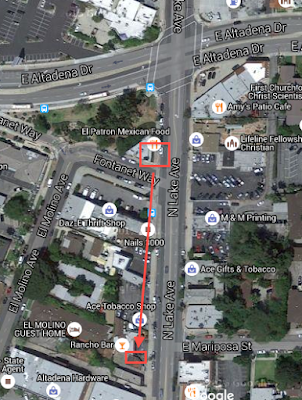
The quirky little structure was originally located at the intersection of Altadena Drive and Lake as one of more than 30 gasoline stations that serviced Altadena in the late 1920s.  

"Traffic Island, Lake Ave at Altadena Dr.,1930s"

Above: The gas station looking east, about 1930.
Red line indicates straightening of Altadena Drive 
in the 1970s. Red circle indicates original 
location of station in the 1920s.
Based on maps in the AHS collection, we believe the structure was moved when the building that now houses El Patron restaurant was constructed, probably in the 1950s.

The building was moved a few blocks south
to it's current location.
La Leche Cafe, in the 2400 block of Lake Ave, is opening soon. Open daily 7 am to 5 pm. The menu includes coffee, tea, pastries, tamales, bagels and more. Their other location is in Highland Park.  Find out more.  

Wednesday, January 27, 2016

HIstoric Look at Altadena's Escalon School - Yesterday and Today

The large estate at 508 Mendocino St. in Altadena has seen better days, but its future looks promising.

The house served as Escalon School beginning in 1977 when owner Luella Huggins deeded the property to the school. According to an L.A. Times article, the school enrolled students with emotional disabilities. But in June 23, 1994 after several years of scraping by on a dwindling budget, it closed.


Pasadena Star-News, June 1977:
"Banner Day - Luella A. Huggins looks on as Bill Hayford, 17, raises a flag in front of her home at 536 E. Mendocino St. in Altadena Friday. Miss Huggins was honored by neighboring Escalon School as she presented the special education school with a deed to her property. Looking on from left are Jimmy Elliot, 12; Bobby Falcone, 16, and Victor Valencia, 15. The four are students at Escalon." (photo from AHS archives)


In 1997 the Altadena Town Council voted against Head Start's attempt to expand the facility and quadruple class size in the wake of complaints from residents in surrounding historic neighborhoods. (L. A. Times, Dec. 18, 1997)

Things are looking up now.  Waldorf School purchased the facility and will open a high school campus there soon.  Stay tuned for more information as it unfolds.

Sunday, December 20, 2015

Bridge from Altadena to Sierra Madre Built After 1934 Flood

The Eaton Canyon Bridge was built after the devastating 1934 flood that nearly wiped out Montrose and La Crescenta. The state-of-the-art metal structure connected Altadena to Sierra Madre via old New York Ave. and Sierra Madre Villa Rd.  

But the 1934 structure was washed away in an even bigger flood in 1969.  That was the flood that took out the El Dorado Inn. 

After that phenomenal rain, the county rebuilt New York Ave. with a concrete bridge. This is the roadway that exists today.

Note the proposed site for the future flood control debris basin
in this 1934 illustration.

The Altadenan, Thursday, April 12, 1934:
"Definite steps have been taken in the foothills area to guard against a recurrence of the terrible fire and flood disaster in La Crescenta and Montrose of several months ago.  Among those steps taken … is the establishment of a sub-station of the Arroyo Seco division, County Forestry Department. This substation is located at the mouth of Eaton Canyon on the new extension of New York Avenue from Foothill Blvd. to Sierra Madre Villa. 
The many fire houses in Altadena and Sierra Madre are given adequate protection by this department which has a 600 gallon tank fire engine.  This service is in addition to the new patrol station's real purpose which is the protection to valuable watershed in the nearby mountains. The protection of the watershed by the station is very necessary, according to forestry official. 
The recently completed road extension from Foothill Boulevard to Sierra Madre and the new bridge which crosses Eaton Wash are two of the things which make the new substation most effective." 

This 1934 map shows New York, the new bridge, and the L. A. County Forestry building. We added the red line to show where New York Ave. runs today.

The old bridge and old road are gone, but the County Forestry substation, a modest arroyo-stone shingle-style cabin-like structure, is still operating.  It's located on the east side of Eaton Canyon wash. You can still see remnants of the old bridge and road if you climb down into the wash directly east of the Eaton Canyon Nature Center.

Thursday, November 5, 2015

AHS Exhibit Features Mountain View Mausoleum

Mountain View Mausoleum
 was the most expensive structure in
L.A. County when it was built in 1925.
 The glorious architecture and artwork of Altadena's Mountain View Mausoleum are celebrated in an Altadena Historical Society exhibit in the back hall gallery at Webster's Community Pharmacy, 

Mezzanine stairway features windows
by L.A. Art Glass Co. and Arts and Crafts
 tile work, possibly by Grueby Faience
Co. and Catalina Pottery.
The dozen color photos in the exhibit show the exterior and interior of the 1925 landmark structure, located on Marengo north of Woodbury.

New Radiance Corridor
Designed by Jae Carmichael
Glass by renowned Judson Studio

The Main Gallery is 180 feet long


Exhibit continues through 
December 1, 2015
Where:  Webster's Community Pharmacy
2450 N. Lake Ave.
Altadena, CA 91001
Open every day but Sunday

Monday, June 22, 2015

La Pintoresca Hotel

La Pintoresca (The Painter Hotel), built and managed by Altadena's Painter family occupied the northeast  corner of North Fair Oaks and Washington in what we might call historic Altadena.  (The hotel was built before Pasadena annexed the area.)  The Painters were close friends with the Gambles and the hotel, like the Gamble House, was very up-to-date for its time.  


Hotel Pintoresca in 1895
The hotel was built in 1888
and destroyed by fire in 1912.
The hotel offered sweeping views of the snow capped San Gabriel range and was popular with tourists and well-heeled Pasadenans.

Sid Galley wrote in an article for the Pasadena Star-News:
"At an elevation of around 1,000 feet and in an era when trees were lacking, there must have been a splendid view from the [hotel's] veranda.  
The Pasadena Star reported on January 15, 1912: "With the exception of the north wing at the west end of the building, containing the kitchen, dining room and servants' quarters, Hotel Pasadena, formerly known as La Pintoresca, located at the corner of Washington Street and Fair Oaks Avenue, was completely destroyed by fire that started at 10:45 o'clock last night. The guests escaped without injury."  
Defective wiring was suspected as the cause of the fire but it started above the room of guest E. Tallman who had just left to catch a train and might have discarded a match when lighting a cigar.  
The fire department arrived soon and fought the fire for several hours. Bellboys ran through the halls alerting guests who grabbed jewelry and other possessions as they left. The jewelry of a few guests was lost in the fire.  
In an editorial, the Star wrote: "Destruction of property by fire is always particularly regrettable. But the burning of Hotel Pasadena, better known as La Pintoresca, is especially to be deplored, because of the aroma of early-day romance that clung to this landmark. Before it was La Pintoresca, it was known as the Painter Hotel, from the Messrs Painter who built it in 1888 and owned and conducted it until a few years ago. In the early youth of the city many a delightful banquet and social function was held within its walls. Perhaps no structure in Pasadena had more romantic memories and associations attached to it. "That there was no loss of life is cause for thankfulness."  
The hotel contained antique furniture brought to the hotel by "Hetty" Green, said to be the richest woman in the world, who was an investor in the hotel. One valuable chair that was saved had been made for Francis Scott Key of Star Spangled Banner fame."
Check out Ann Erdman's informative blog post about La Pintoresca that features these rare photos:


Today the lovely La Pintoresca Branch Library, built in 1930 and named after the hotel, is situated on a small piece of the original property.  

Monday, May 18, 2015

Altadena's Miniature Golf Course

If you recall back 50 years, when the purple and white building on Lake Ave just south of Amy’s restaurant was The Venetian, you might remember the miniature golf garden that was built on the property in the 1920s.  The recreational attraction closed during the depression but the mini buildings dotting the little course were still there. In fact, a few of them remain to this day including the pint sized church featured in the photo below.  


Sidewalks still wind through the course ruins and remnants of a little water hazard remain.
The Altadena Golf Garden
piped in music over loud speakers.
More recently the location has served as a church.  The church sold the property a few months ago. Plans to raze the building (and the golf course) to build medical offices is on hold due to parking issues.  

Monday, May 4, 2015

The Altadena Press

Before ALTADENA NOW and altadenblog, there was the...


COX-O-TYPE Schwart-Seymore 
Flat Bed Web Newspaper Press

The mammoth press was installed at Altadena Press, 750 E. Mariposa (today the building west of liquor store on south side of Mariposa), on Thursday, August 26, 1937. This is what the building looked like in 1937.

The Cox-O-Type Schwart-Seymore Press weighed 10 tons and  modernized newspaper publishing, speeding up printing and folding in one operation.  It changed the size, make-up, and copy style of the The Altadena Press, first published in 1928.  


The paper stated, "The Altadena Press will adopt the newer trend toward "streamlined" newspapers, which will make the paper more easily read and will present the news content in a smarter, clearer page make-up." The publishers felt sure that readers of the press would be pleased with the efforts that were made to "give Altadena only the finest type newspaper - one in keeping with the high ideals and conceptions of the fine southland community."

Monday, February 23, 2015

Switzer Camp

(These photographs of Switzer Camp in the San Gabriels
are courtesy of a friend of Altadena Historical Society.)


Founded in 1884, Switzer Camp was the idea of Perry Switzer who lived in Pasadena and made his living as a carpenter. His arroyo rock village, one of many privately owned attractions that dotted the front range of the San Gabriel mountains, hosted outdoor enthusiasts who hiked from one lodge to the next.


Inside the lodge
In 1896 Switzer Camp was destroyed by forest fire. In 1905, when the camp was rebuilt the name was changed to Camp Losa-Dena (a combination of Los Angeles and Altadena).  It changed hands again in 1911, and was renamed Switzer-Land.  The chapel, perched precariously above the falls, was built after 1911.
The chapel, built from canyon arroyo rock, 
had a piano, bell tower and stained 
glass window. It held 200 people.

Today all that remains of Switzer Camp are the chapel's arches and the overgrown foundation of the lodge. Hikers can access the shady canyon and falls area from Angeles Crest Highway (CA 2).
View from the chapel

To see all 46 photos go to this link.

Monday, February 9, 2015

Altadena's James McFadden House

James McFadden, who founded Balboa Island and Newport Beach in the 1860s, built Villa Mara on the northwest corner of Altadena Drive and Holliston. The prairie-style estate was built in 1913 for $70,000.  

The McFadden family sold the property to "South American Doctor" Dr. and Mrs. J. S. Passeron of Buenos Aires.  It was listed in the real estate section of The Altadenan June 30 1938.  
"…Sale of the well known Jennie E. McFadden estate, a large two story semi-Colonial stucco [house] consisting of more than an acre of beautiful landscaped grounds with many rare ornamental trees and shrubs adorning the place." 
Villa Mara Today

Read more about Villa Mara

Monday, January 26, 2015

Altadena's Kate Crane Gartz House

Adolph and Kate Crane Gartz built  a spectacular $25,000 house on the northwest corner of Mariposa and Santa Rosa in 1908.  (The house was razed in 1953. Today the property is a Girl Scout camp.)
Kate Crane Gartz was heiress to Crane Plumbing Company.

AHS has only one photo of the home's exterior so imagine our surprise when we came across the picture below on google images that shows the interior of the house.


Under the photo it says:  Drawing-room of
"The Cloister," where radical lectures are given.

Author Michele Zack tells us that Kate Crane Gartz was "a woman of progressive ideas. The Cloisters, as their home was called, became the center for political, cultural, and civic activities in the teens and continued in that capacity after Adolph's death in 1930." (Altadena: Between Wilderness and City, 2003, p. 125 ) 

Mrs. Gartz was committed to social justice and political reform. For thirty years she hosted a salon for intellectuals including Upton Sinclair, Charlie Chaplin, Albert Einstein and others.

Monday, January 5, 2015

Altadena's Masonic Lodge


Inscribed "Altadena Masons"
The Masonic Lodge which today serves as a private school is located on the south side of Mendocino just east of Lake.  We don't know much about the building's history in between the time it was built in 1938 (per the Altadena Press article below) and now.  

The architect's sketch in 1937. 


The building today.
If you know anything about the history of the Masons in Altadena, please let us know.